How Retail Pharmacy Software Expands Patient Care and Billing
 Iron Bridge
 Walk into any busy community pharmacy today and you'll feel the shift. We're no longer just counting pills behind a counter, we're coordinating care, monitoring adherence, and navigating real-time payer rules. Retail pharmacy software sits at the center of that transformation. By unifying prescription processing, clinical checks, inventory, and billing, it lets us work faster and smarter while keeping patient safety front and center. And when those tools are tied into EHRs, registries, and payers, the gains compound: fewer errors, quicker refills, cleaner claims, and better outcomes. In this text, we break down what retail pharmacy software is, how it expands patient care, and why it's becoming essential for revenue cycle performance, plus where data integration is taking us next.
Introduction
Retail pharmacy software is changing how we deliver care and get paid for it, without adding friction for patients. We're seeing safer dispensing powered by real-time drug interaction checks, faster prescription fills through e-prescribing, and staff freed from repetitive tasks thanks to automation. On the billing side, integrated claims workflows mean fewer denials and faster reimbursements.
The common thread is interoperability. When pharmacy systems connect with EHRs, state vaccine registries, payers, and POS, they create a connected care and billing experience that patients actually feel: accurate meds, timely refills, and clear costs. For pharmacy owners and healthcare leaders, it's a practical way to elevate patient care while improving cash flow and compliance.
The Changing Role of Pharmacies in Patient Care
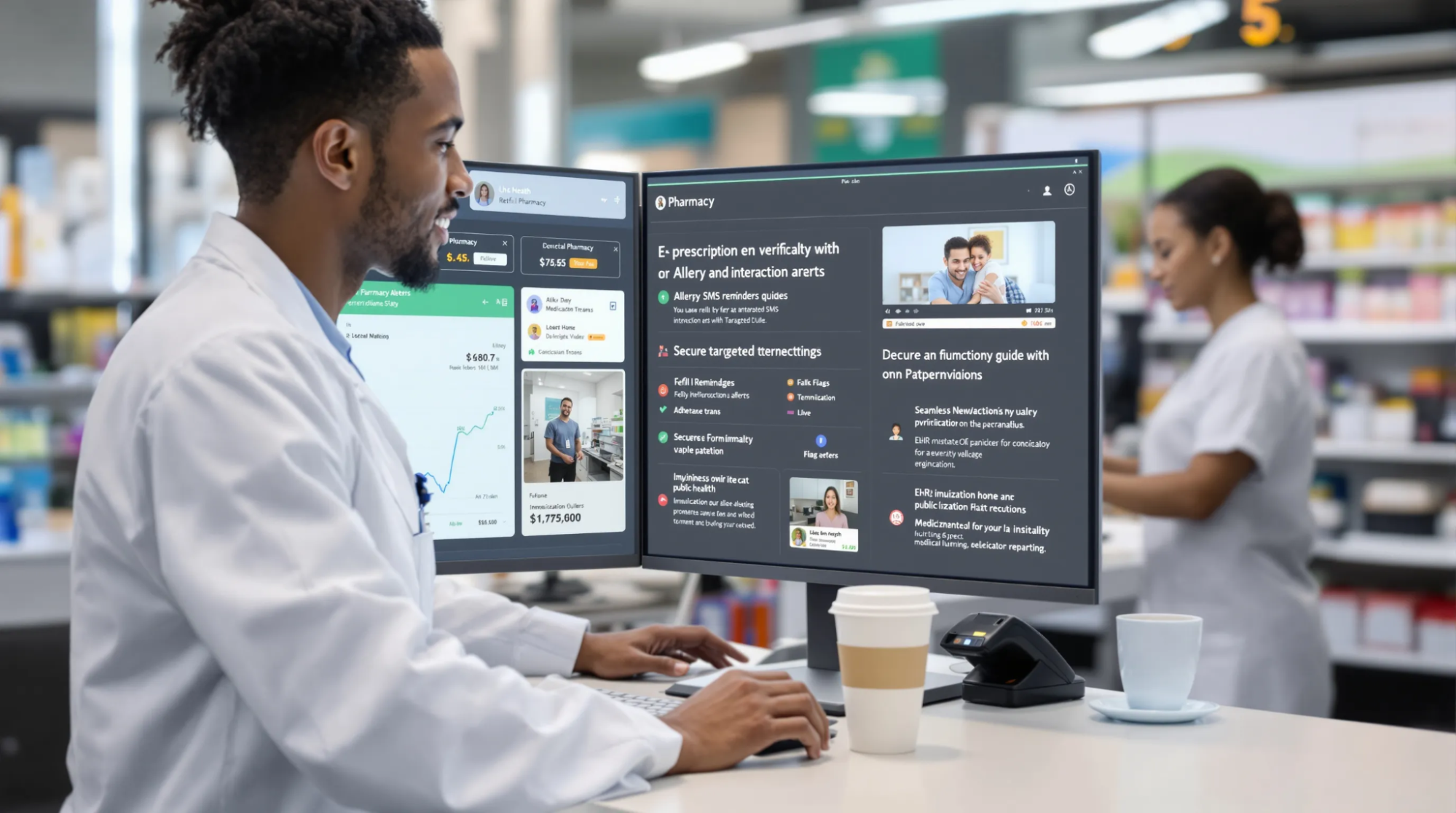
Pharmacies have moved from transactional dispensaries to active care partners. We're counseling on complex regimens, coordinating with prescribers, and supporting chronic disease management, often as the most accessible touchpoint in a patient's week. Retail pharmacy software is the engine behind that shift.
A typical day now includes e-prescription verification, on-screen allergy and interaction checks, targeted SMS refill reminders, and documentation that flows back to providers. Telepharmacy and secure messaging let us meet patients where they are, at home, at work, or in rural communities. We can track adherence, flag gaps in care, and nudge patients when a refill or immunization is due.
These capabilities aren't just "nice to have." They're essential as chronic conditions rise and health plans expect measurable outcomes. When our software ties into EHR data and public health systems, we're able to contribute immunization records, reconcile med lists, and reduce duplicative therapy. The result is a more coordinated care loop where pharmacists play a clear, clinical role, without losing the speed and convenience patients count on.
What Is Retail Pharmacy Software?
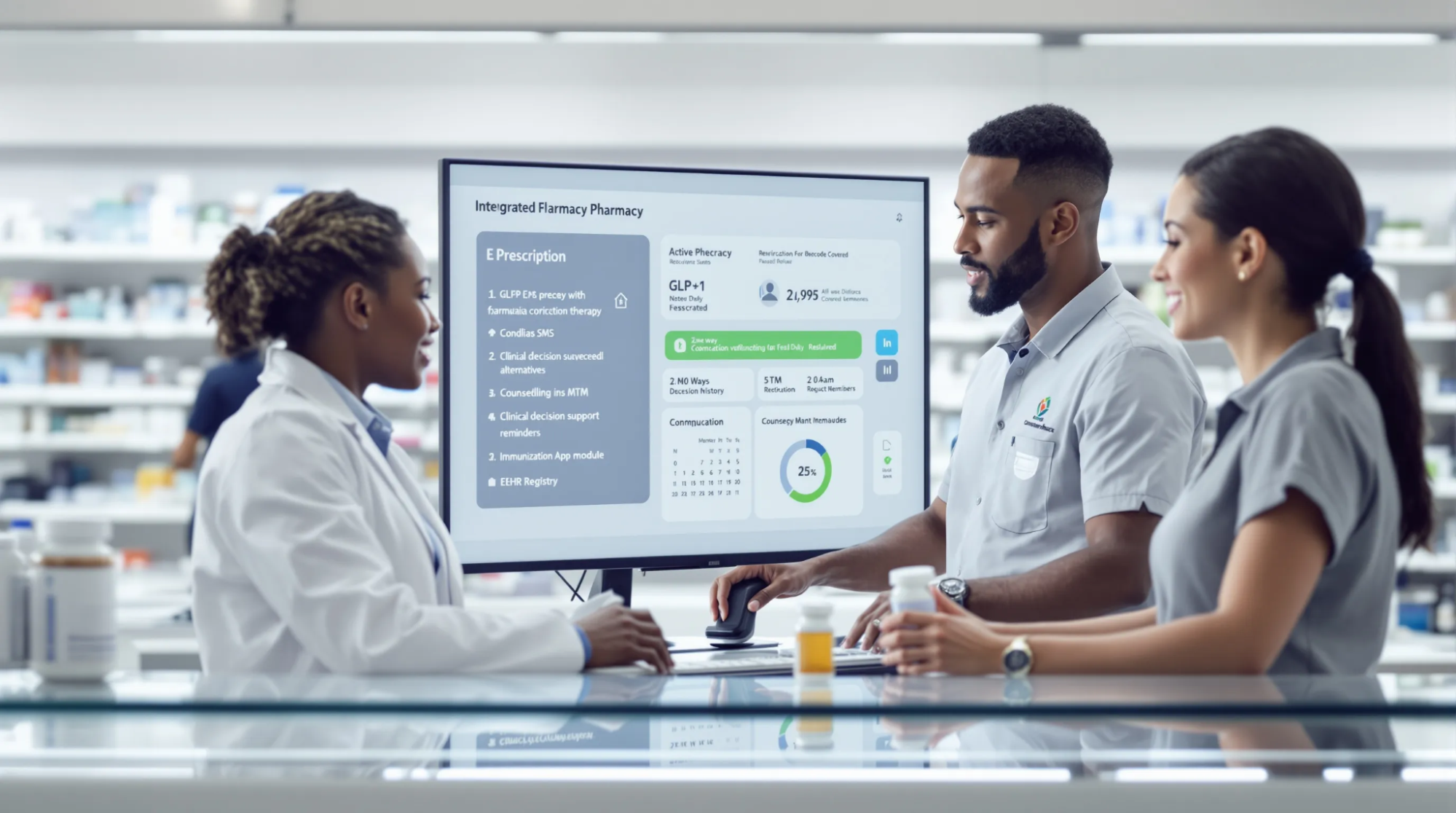
Retail pharmacy software is a specialized platform that automates core pharmacy operations: prescription intake and processing, patient profiles, allergy and drug interaction checks, barcode-supported dispensing, inventory management, POS, and analytics. The best systems integrate with e-prescribing networks, EHRs, and payer portals to reduce manual work and minimize errors.
Key capabilities typically include:
- E-prescriptions with real-time eligibility and formulary checks
- Centralized patient records with histories, conditions, and allergies
- Inventory and purchasing controls with predictive replenishment
- Compliance documentation and audit trails
- POS integration for transparent pricing and copay collection
- Dashboards and reports for clinical, operational, and financial insights
Whether you're an independent, a regional chain, or a health-system outpatient pharmacy, modern platforms scale to your workflows and regulatory requirements.
How Retail Pharmacy Software Expands Patient Care
When dispensing and clinical checks happen in one place, and in real time, patient care gets both safer and more personal.
- Fewer errors at the counter: E-prescriptions eliminate handwriting ambiguity. Built-in clinical decision support flags duplications, interactions, and dose issues before a label prints. Barcode verification at fill and will-call prevents mix-ups.
- Better adherence with less chasing: Automated refill reminders via SMS/email, two-way messaging, and mobile apps reduce missed doses. Patients can approve refills or ask questions without a phone queue.
- Context-rich counseling: With a consolidated profile (conditions, labs where available, allergies, and med history), we can tailor counseling on side effects, food interactions, and timing. For polypharmacy patients, a MTM session is more precise and documented.
- Vaccination and preventive care: Integrated immunization modules schedule vaccines, capture consent, and submit records to state registries. That keeps patients current and helps providers close gaps in care.
- Continuity across care settings: When pharmacy software connects to EHRs and health information exchanges, we can reconcile meds post-discharge, spot conflicts, and coordinate with care teams in hours, not days.
A quick example: a patient with diabetes receives an eRx for a new GLP-1. The system checks coverage, suggests a covered alternative if needed, screens for interactions, enrolls the patient in refill reminders, and schedules a follow-up counseling touchpoint. The patient gets the right therapy sooner, and stays on it longer, without juggling calls between the pharmacy, prescriber, and plan.
Impact of Retail Pharmacy Software on Medical Billing

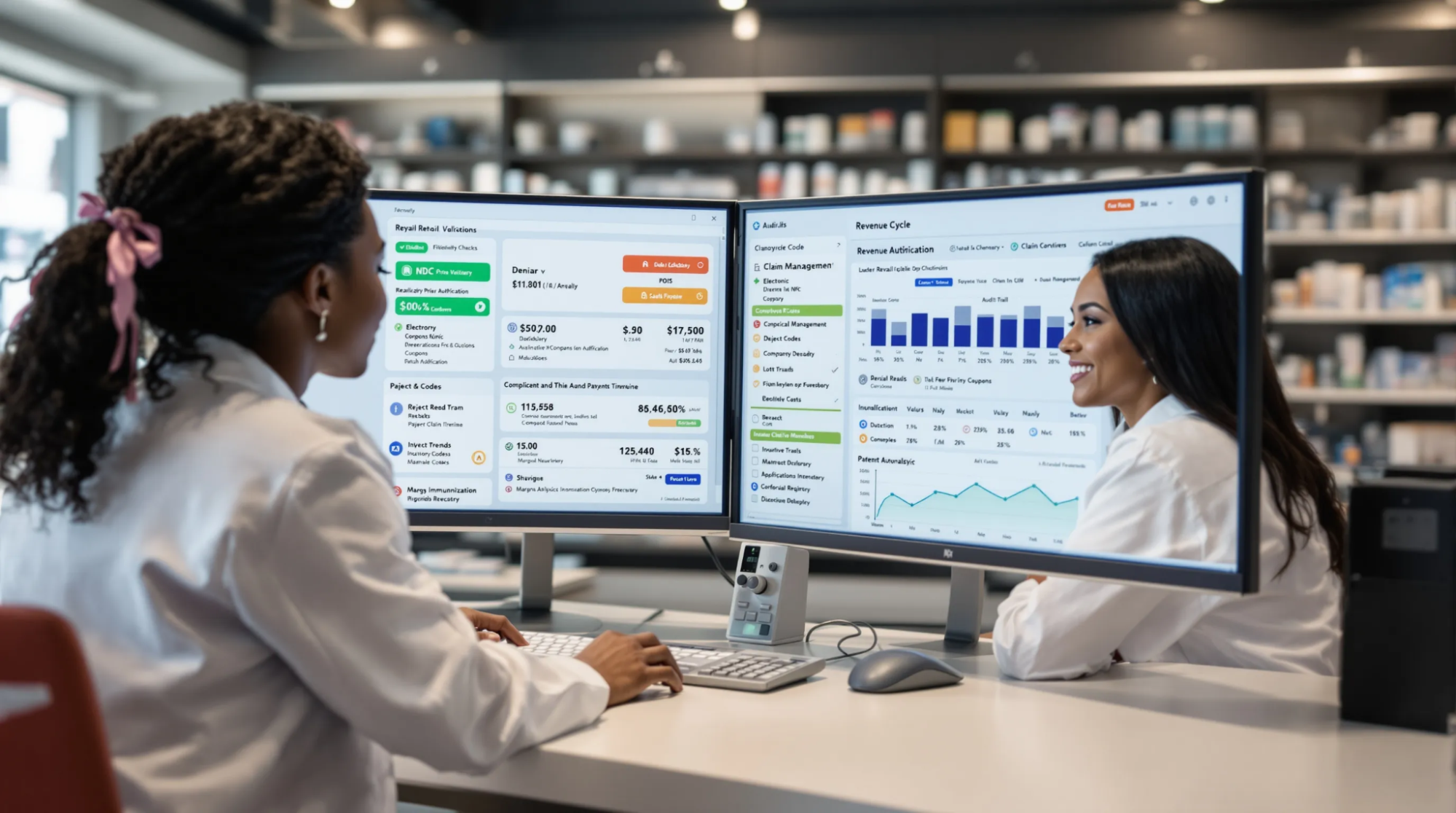
Billing is where small inefficiencies snowball into denials and delayed cash. Retail pharmacy software tightens the revenue cycle by aligning clinical, POS, and payer data.
- Cleaner claims, faster payments: Real-time eligibility (RTE), formulary checks, and NDC validation reduce rejects before submission. Electronic prior authorization workflows shorten time-to-fill. Fewer resubmissions means better days sales outstanding (DSO).
- Integrated POS and audit trails: Copays, coupons, and patient responsibility flow directly from the claim adjudication into the POS, minimizing reconciliation headaches. Every transaction leaves a compliance-ready trail.
- Denial management that actually closes the loop: Dashboards highlight reject codes and payer trends. Staff can work denials in-batch, resubmit with correct data, and track status, all within one system.
- Inventory-cost alignment: Acquisition costs, lot numbers, and dispense data tie to claims, enabling accurate margin analysis by drug, payer, or prescriber. That insight informs purchasing and pricing decisions.
- Regulatory confidence: From HIPAA safeguards to state-specific documentation for controlled substances and immunizations, compliance features keep audits boring, in the best way.
When platforms are built for interoperability, even public health data can support billing quality. For example, submitting immunization records to state registries in real time helps demonstrate quality measures tied to payer incentives.
Benefits for Pharmacies and Patients
For pharmacies, retail pharmacy software unlocks tangible wins:
- Accuracy and safety: Automated checks and barcode verification reduce dispensing errors.
- Efficiency: Task automation and integrated workflows free up staff time for counseling and services.
- Inventory control: Real-time tracking reduces stockouts and waste.
- Financial performance: Cleaner claims, fewer denials, and faster reconciliation improve cash flow.
- Compliance made simpler: Built-in documentation and reporting reduce audit risk.
For patients, the benefits are just as clear:
- Safer meds via allergy and interaction screening
- Transparent costs at the counter, with copays surfaced early
- Timely refills and reminders that boost adherence
- Easier access to records, vaccination history, and counseling
When both sides win, satisfaction rises, and so do outcomes.
The Future of Retail Pharmacy Software and Data Integration
The next wave is all about deeper connectivity, intelligence, and patient-centric experiences.
- Interoperability by default: Cloud-first platforms will sync with EHRs, payer APIs, and state/territorial registries in real time, reducing manual touchpoints and data drift.
- Advanced analytics: Population health views will surface care gaps, adherence risks, and payer opportunities, helping us target interventions efficiently.
- AI-driven support: Predictive inventory, clinical risk flags, and smart workflow routing will reduce waste and elevate clinical focus.
- Patient experience: Mobile-first tools will expand two-way engagement, enabling refills, prior auth updates, copay transparency, and vaccine scheduling without phone tags.
At Iron Bridge, we've seen how robust connections accelerate care. Our Pub Hub platform links providers and pharmacies with all 64 U.S. state and territorial vaccine registries, supporting dynamic, state-specific validation and high-volume submissions. When pharmacy systems tap into this kind of healthcare data exchange, immunization services become seamless extensions of everyday care.
Conclusion
Retail pharmacy software is now central to how we care for patients and sustain the business that supports that care. By unifying clinical checks, dispensing, interoperability, and billing, it turns the pharmacy into a truly connected health hub. The payoff is practical, safer meds, smoother refills, cleaner claims, and visible to patients at the counter and on their phones.
As data integration deepens across EHRs, payers, and public health, pharmacies will play an even larger role in preventive and chronic care. Our job is to choose interoperable tools, design efficient workflows, and keep the patient experience simple. Do that, and the technology fades into the background, while outcomes, satisfaction, and revenue all move in the right direction.
Frequently Asked Questions
What is retail pharmacy software and how does it work?
Retail pharmacy software is a platform that unifies prescription intake, clinical checks, dispensing, inventory, POS, and billing. It supports e-prescribing, drug interaction and allergy alerts, barcode verification, real-time eligibility and formulary checks, and analytics. Integrated with EHRs and payers, it reduces errors, speeds fills, and improves patient and financial outcomes.
How does retail pharmacy software improve medical billing and reimbursement?
By aligning clinical, POS, and payer data, retail pharmacy software prevents rejects with real-time eligibility, formulary, and NDC validation. Electronic prior authorization shortens time-to-fill. Integrated POS pulls copays from adjudication, while denial dashboards streamline resubmissions. Tying inventory costs to claims clarifies margins and accelerates cash flow with fewer denials.
How does EHR and registry integration enhance patient care in pharmacies?
EHR and vaccine registry connectivity creates a coordinated care loop. Pharmacists reconcile meds post-discharge, access context for counseling, submit immunization records in real time, and automate refill and care-gap reminders. Patients experience safer dispensing, timely refills, and transparent costs, while providers see up-to-date records and fewer duplications or therapy conflicts.
What should pharmacies consider when choosing retail pharmacy software?
Prioritize interoperability (EHRs, payer APIs, immunization registries, POS), usability for fast workflows, scalability for multi-site growth, security and HIPAA safeguards, robust analytics, and denial management. Evaluate implementation timeline, data migration, vendor support, uptime SLAs, and total cost of ownership—including interfaces, training, and ongoing maintenance.
How much does retail pharmacy software cost, and when is ROI typical?
Pricing varies by features and scale, often ranging from a few hundred to several thousand dollars per store per month, plus setup and interface fees. Many pharmacies see ROI in 6–12 months through reduced claim denials, labor savings from automation, better inventory turns, and improved adherence-driven reimbursement performance.