How Healthcare Data Integration Improves Clinical Decision Support
 Iron Bridge
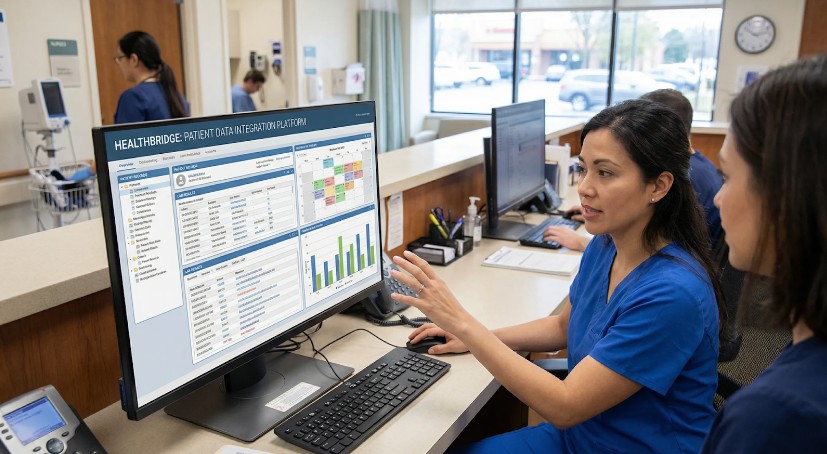
Healthcare data integration improves clinical decision support by unifying fragmented patient data into a complete, real-time view, enabling faster, more accurate clinical decisions.
Nearly 80% of healthcare data remains unstructured and siloed across disconnected systems. That means critical insights are often unavailable when clinicians need them most.
Healthcare data integration eliminates this gap by connecting systems and standardizing data flow, making comprehensive patient information accessible at the point of care.
For modern providers, this is no longer optional. It is foundational to deliver safe, efficient, and data-driven care.
Healthcare Data Integration: What Is It?
Healthcare data integration is the process of combining clinical, administrative, and operational data from multiple systems into a unified, accessible view.
Instead of navigating disconnected platforms, clinicians can access a complete patient record in one place.
This offers real-time clinical decision support and answers a key question: What is decision support in healthcare? It is the use of integrated data to guide clinical decisions.
The Current State in the United States
Healthcare data in the United States is still highly fragmented despite widespread EHR adoption.
Federal efforts like the Health Information Technology for Economic and Clinical Health (HITECH) Act improved digitization, but interoperability remains limited.
Key barriers include:
- Persistent data silos across providers and systems
- Inconsistent use of standards like HL7 FHIR
- Continued reliance on legacy HL7 v2 messaging
- Lack of a national patient identifier
- Gaps between data exchange and actual usability
According to the ONC, many organizations can exchange data, but fewer can effectively use it within clinical workflows.
This limits the impact of CDs in healthcare and weakens medical decision support systems.
Why Integration Matters
Healthcare data integration helps close this gap by:
- Standardizing data across systems
- Enabling real-time access to complete records
- Supporting interoperability at scale
- Strengthening clinical decision support systems
Common Data Sources
- Electronic Health Records (EHRs)
- Laboratory Information Systems (LIS)
- Pharmacy and medication systems
- Imaging platforms (PACS)
- Billing and claims systems
- Public health registries (IIS)
When these systems connect, they power clinical decision support and improve outcomes across the care continuum.
Importance of Healthcare Data Integration
Healthcare data integration serves as the foundation for effective medical decision support systems. Without it, even advanced tools rely on incomplete or outdated data.
With it, organizations unlock measurable improvements in care quality, efficiency, and compliance. IronBridge Corp understood this need with its Pub Hub Data Integration solution.
1. Enhanced Clinical Decision Support
Clinical decision support systems (CDSS) depend entirely on data quality.
Integrated systems strengthen CDs in healthcare by delivering:
- Complete medication histories across providers
- Real-time lab results and vital trends
- Alerts for drug interactions and contraindications
- Identification of care gaps, such as missed immunizations
These capabilities highlight the benefits of clinical decision support systems, including:
- Reduced diagnostic errors
- Fewer adverse drug events
- More consistent, evidence-based care
In short, better data leads to better decisions.
2. Stronger Clinical Information System Benefits
Integration amplifies the benefits of clinical information systems by eliminating inefficiencies and improving data accessibility.
Organizations gain:
- Reduced duplicate data entry
- Faster access to patient records
- Improved coordination across departments
- More accurate and timely reporting
This strengthens the overall decision-support system in the healthcare industry, making it more reliable and actionable.
3. Integrated Operations and Reporting
Integrated data simplifies operations across healthcare organizations.
Instead of manually reconciling data, teams can:
- Generate population health reports instantly
- Track quality metrics in real time
- Automate lab and immunization reporting
- Respond quickly to public health requirements
This reduces administrative burden and frees staff to focus on patient care. IronBridge Corp.'s Pub Hub Rapid Report lab reporting solution helps in achieving this goal.
4. Improved Regulatory Compliance
Healthcare regulations demand secure, accurate, and timely data exchange.
Healthcare data integration supports compliance by:
- Standardizing data flows
- Creating auditable data trails
- Enabling faster reporting for audits
- Reducing the risk of penalties
When systems are integrated, compliance becomes proactive rather than reactive.
Common Challenges in Healthcare Data Integration
Although healthcare data integration offers clear benefits, organizations still face several challenges when implementing it.
1. Data Silos and Legacy Systems
Many healthcare systems were not originally designed to share data. As a result, information often remains isolated within departments or platforms.
In these cases, organizations must work around:
- Proprietary data formats
- Limited system interoperability
- Costly custom integrations
Over time, breaking down these silos requires both technical upgrades and organizational alignment.
2. Lack of Standardization
Healthcare data often lacks consistency across systems. Different platforms may use different coding standards or data formats.
For example:
- One system may use ICD-10, while another uses SNOMED CT
- Data may arrive in HL7 v2 or FHIR formats
Without standardization, integration efforts can slow down or produce unreliable results. Therefore, normalization becomes a critical step in the process.
3. Data Privacy and Security Risks
At the same time, every integration point introduces potential security risks. Organizations must ensure that data remains protected throughout its lifecycle.
To address this, they implement:
- Encryption for data in transit and at rest
- Role-based access controls
- Continuous monitoring and audit logging
By prioritizing security, organizations protect sensitive information while maintaining compliance.
Key Integration Approaches and Standards
To support healthcare data integration, organizations rely on a combination of standards and technologies. Each approach plays a specific role in enabling interoperability.
1. HL7 and FHIR
HL7 v2 continues to support traditional messaging between systems. Meanwhile, FHIR enables more flexible, API-based data exchange.
Together, these standards form the backbone of modern interoperability.
2. API-Based Integration
APIs allow systems to request and exchange data in real time. As a result, organizations can support faster and more responsive clinical decision support.
3. ETL Pipelines
ETL processes help organizations consolidate data into centralized systems. This approach supports reporting, analytics, and population health management.
4. Health Information Exchanges (HIEs)
HIEs provide shared infrastructure for data exchange across organizations. Through these networks, providers can access patient data beyond their own systems.

Best Practices for Seamless Healthcare Data Integration
Successful healthcare data integration requires more than selecting the right tools. Organizations need a clear plan that aligns technology, data management, and business goals so systems work together and deliver reliable data for clinical decision support.
Key Best Practices
- Start with clear use cases. Defining the exact problems integration will solve sets the foundation for success. Whether the priority is improving clinical decision support, automating public health reporting, or reducing duplicate records, clarity keeps efforts focused and avoids unnecessary complexity.
- Adopt interoperability standards early. Implementing standards like HL7 FHIR from the outset enables smoother communication between systems, minimizes future rework, and supports long-term expandability.
- Invest in data governance. Establishing clear policies for data ownership, quality, and access ensures consistency and reliability, which are essential for effective decision-making.
- Prioritize security at every layer. Protecting sensitive data requires encryption, role-based access controls, and ongoing security assessments. Embedding security throughout the process reduces risk and strengthens compliance.
- Choose expandable solutions. Selecting systems that can handle growing data volumes without performance issues or rising costs helps organizations stay efficient as data demands increase.
- Test with real-world data. Validating integrations using real or production-like data in secure environments helps uncover issues early and ensures systems perform as expected before going live.
The Role of Cloud-Based Platforms
Cloud platforms continue to reshape healthcare data integration by reducing infrastructure complexity and improving accessibility.
Instead of maintaining on-premise systems, organizations can rely on cloud-based solutions to manage data more efficiently.
Key Benefits
- Lower upfront costs
- Faster deployment
- Automatic updates
- Elastic adaptability
- Built-in compliance features
In addition, cloud platforms enhance medical decision support systems by enabling real-time data access and analytics.
Building a Data-Driven Healthcare Organization
Healthcare data integration transforms how decisions are made across the healthcare system.
By connecting data sources and improving accessibility, organizations strengthen CDs in healthcare, improve efficiency, and deliver better patient outcomes.
As organizations connect their systems, they create a more complete and reliable data environment. Over time, this leads to:
- Faster and more accurate diagnoses
- Fewer medical errors
- Improved operational efficiency
- Better patient outcomes
The future of healthcare depends on effective clinical decision support powered by integrated data. Organizations that delay risk falling behind.
At IronBridge Corp, we specialize in cloud-based healthcare integration solutions that make secure health data exchange affordable and achievable.
Whether your organization needs EHR integration, electronic lab reporting, or seamless connections to state immunization registries, our Pub Hub platform eliminates complexity, so you can focus on what matters most: better patient outcomes.
Reach out to our team today to see how we can simplify your healthcare data integration strategy.
**Relevant Reading: ** How Retail Pharmacy Software Expands Patient Care and Billing
Frequently Asked Questions
Why is healthcare data integration important for clinical decision support?
Clinical decision support systems depend on complete, accurate, and timely data. Integration ensures that a CDSS has access to a patient's full medical picture, reducing errors, flagging potential risks, and supporting more informed treatment decisions.
What standards are used in healthcare data integration?
The most widely used standards include HL7 v2 for traditional messaging, HL7 FHIR for modern API-based data exchange, and ICD-10 and SNOMED CT for clinical terminology. Many organizations use a combination depending on their systems and use cases.
How does cloud-based integration differ from on-premise solutions?
Cloud-based integration eliminates the need for dedicated servers and expensive software licenses. It offers faster deployment, automatic updates, elastic versatility, and built-in security features, making it a more flexible and cost-effective option.
How does healthcare data integration improve clinical decision-making?
Integrated data feeds clinical decision support systems with comprehensive, real-time patient insights. This allows a CDSS to flag drug interactions, surface lab trends alongside vitals, and identify gaps in preventive care, leading to measurable reductions in adverse drug events and diagnostic errors.
How can IronBridge Corp help with healthcare data integration?
IronBridge Corp provides cloud-based integration solutions through its Pub Hub platform, enabling secure EHR integration, electronic lab reporting, and automated connections to state immunization registries without the overhead of traditional on-premise infrastructure.